
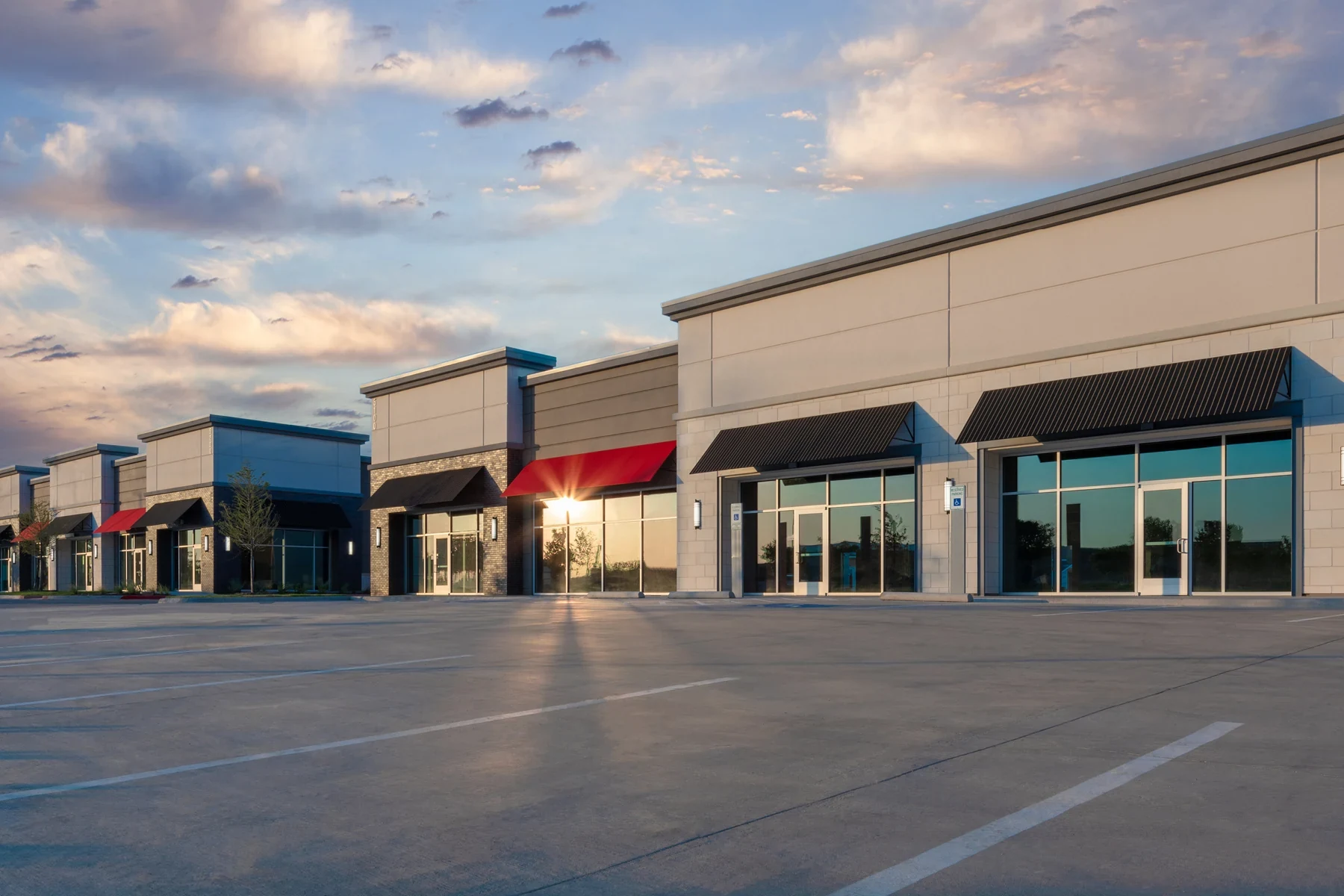


Managing One Roof Over Ten Different Leases Without Ten Different Headaches
Strip centers along US-501, the 17 Bypass, and the growing retail corridors near Coastal Grand Mall usually share one continuous roof over a row of separate tenants, which means a leak over the nail salon can just as easily show up on the phone store's ceiling three units down. We work directly with property managers to keep one roof system performing for every lease it covers.
One Membrane, Many Leases
Most strip center roofs were built as a single low-slope system running the full length of the building, with parapet walls separating tenant spaces below but no actual break in the roof membrane above. That means a repair, recover, or reroof decision for one unit's leak almost always has to account for the whole field rather than only the section over that storefront.
We map drainage paths, existing patch history, and membrane condition across the entire roof before recommending anything, because a spot repair over unit 4 that ignores ponding water draining from units 2 and 3 just moves the problem instead of fixing it.
Rooftop HVAC is usually split by tenant even when the roof isn't, so we also track which curb belongs to which unit's system so any work order references the right equipment and the right lease.
Strip centers built in phases over multiple decades sometimes have two or three different membrane types tied together across the same roofline, each added during a different expansion or renovation. We identify those transition points early since they're consistently where we find the most seam failures and the least consistent flashing detail.
CAM Documentation Property Managers Actually Need
Common area maintenance billing depends on clean documentation of what was done, where, and why. We provide itemized scope, photos, and location references tied to specific roof zones so a CAM reconciliation doesn't turn into a dispute with tenants questioning what they're being charged for.
That documentation also matters when a strip center changes ownership or management companies, since the roof's service history is one of the first things a new owner's due-diligence team asks for.
We also keep a running log across visits rather than treating each service call as a standalone event, so a property manager can pull a full maintenance history for a lender, an insurer, or a prospective buyer without having to reconstruct it from separate invoices.
Sequencing Work So No Storefront Closes
A tenant running a retail storefront can't close for a roof project the way an empty warehouse bay could. We section repair and reroof work unit by unit, closing in each zone before moving to the next, and we keep material staging in the rear service area rather than the customer parking lot whenever the site layout allows it.
Noise-sensitive tenants - a nail salon, a massage studio, a small medical office - get their section scheduled for early morning or a slower weekday when the property manager flags them in advance.
We also give the property manager a section-by-section calendar up front rather than a single project end date, so tenant notices can go out unit by unit instead of one blanket notice that makes every storefront think their business is affected on day one.
What We Check on Every Strip Roof Visit
New tenant buildouts are another point where strip center roofs quietly pick up damage. An HVAC swap, a new exhaust hood, or a satellite dish mount installed by a tenant's own contractor during a fit-out often skips proper roof flashing entirely, and we ask property managers to loop us in on any tenant buildout that touches the roofline so it gets inspected before it becomes a leak.
- Membrane condition and seam integrity across the full field beyond the reported leak zone
- Ponding water locations relative to actual drain and scupper placement
- Parapet wall flashing at every tenant division
- Rooftop HVAC curb condition mapped to the correct tenant unit
- Patch history and whether prior repairs were tied properly into the field membrane
- Signage and conduit penetrations added by tenants after original construction
That last item catches more surprise leaks than anything else on a strip center roof - a sign installer or cable contractor cutting a new penetration without flashing it correctly is one of the most common causes of a call we get.
Questions Property Managers Ask Us
Who's responsible for a repair when the leak affects two different tenants?
We document the actual source location on the roof regardless of which storefronts show interior damage, and provide that to you so lease and CAM responsibility can be sorted on your end with clear facts.
Can you give us photos and a written scope for CAM billing?
Yes, every service visit and repair comes with location-tagged photos and an itemized scope you can use directly in reconciliation.
Do you work around individual tenant hours?
We schedule noise-sensitive or storefront-adjacent work for whatever window you or the tenant flags as least disruptive, and we coordinate directly with tenants when needed.
How do you handle penetrations tenants added themselves, like signage or antennas?
We flag any unflashed or improperly flashed penetration we find during an inspection, whether it was part of original construction or added later by a tenant's vendor, and correct it as part of the scope.
Should we recover or replace a roof that's only leaking in one section?
That depends on what the moisture scan shows across the whole field - if the rest of the roof is dry and sound, a targeted repair or partial recover is usually the right call instead of a full reroof. We'll walk you through the scan results directly, including where the property's history is thin, so the decision isn't a leap of faith on your end.